Studying the diachronic development of chromaticism and dissonance in western music over three centuries
Abstract
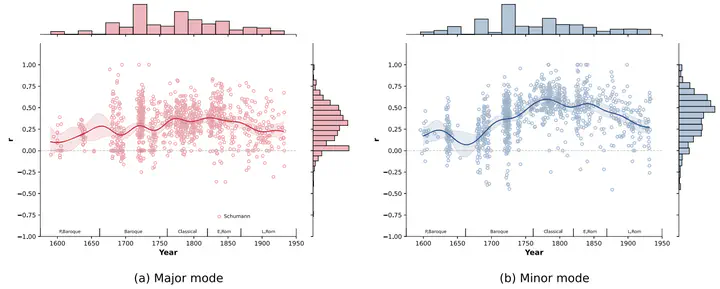
The historical narrative of increasing chromaticism and dissonance in Western music, while widely accepted, has predominantly relied on traditional close-reading analyses of individual works rather than comprehensive empirical validation. This study presents a computational analysis of a large-scale dataset—comprising over 230,000 expert-annotated harmonic labels from 1280 musical works spanning three centuries—to quantify and trace the diachronic development and co-evolution of chromaticism and dissonance. We introduce novel quantitative indices measuring chromaticism and dissonance to evaluate stylistic evolution in different musical periods. Our findings empirically validate the established narrative of a gradual rise in both chromaticism and dissonance, and further reveal a more nuanced trajectory characterized by modal differences and a persistent diatonic foundation alongside chromatic and dissonant experimentation. Adopting a “distant listening” approach, this study provides a systematic and quantitative perspective on the evolution of chromaticism and dissonance, complementing traditional musicological approaches and providing novel, data-driven insights into the evolution of Western tonal music.

Fabian C. Moss
Digital Music Philology and Music Theory
Fabian C. Moss is an assistant professor for Digital Music Philology and Music Theory at Julius-Maximilians University Würzburg (JMU), Germany.